Future Design Inquiries. December 2025
Hello from ENSO, a future design company. We’re sharing the things that make us think, bring us joy or shift our perspective.
What we’re reflecting on
The Original Tech Panic
“It is my belief that social intercourse cannot long continue what it has been…The easy gossip, the merry yet unambitious jest, the practical discussion of real matters in a casual way—the soul of truth—will disappear from the earth. Conversation will take on the air of debate, and all mortal intercourse will be chilled with a fatal frost.”
Sounds like a (19th century) thought leader predicting the consequences of social media, or the smartphone, doesn’t it? In reality, it’s Nathanial Hawthorne complaining about the transition from the open hearth to the stove. “These barren and tedious eccentricities are all that the air-tight stove can bestow in exchange for the invaluable moral influences which we have lost by our desertion of the open fireplace. Alas!”
I bet you didn’t know that your stove lacked moral influences.The quote came up in a conversation between historian Daniel Immerwahr and Adam Grant and it reminded me that predicting society’s collapse at the hands of new technology is one of humanity’s oldest pastimes. And of course when you’re living through a transition (*cough*), it’s nearly impossible to have perspective. But it’s worth remembering that – even today – no era is completely unprecedented, and no technology is without side effects. The trick is in remembering that we have some agency to design where things go from here. What we choose to amplify—connection, creativity, agency—matters far more than the tools themselves. The stove didn’t end conversation; it simply asked us to invent new ways to gather. And we did. (HS)
Designing creative destruction
Creative destruction is the story of 2025. The economic thesis — that growth happens when the new replaces the old in an endless cycle of progress — underpinned the work that won the 2025 Nobel Prize in Economics for Joel Mokyr, Philippe Aghion, and Peter Howitt. The idea applies beyond economics: it helps explain why voters around the world are turning out incumbents, and it’s the dominant metaphor for the upheaval (and layoffs) unleashed by artificial intelligence. Even the demolition of the East Wing reads like a physical manifestation of a broader mood: out with the old, in with the uncertain new. The thesis can feel disempowering: Joseph Schumpeter described it as a “perennial gale” sweeping away old industries. But the work that won this year’s Nobel showed that unlike the weather, creative destruction is not a story of inevitability — it’s a design challenge. They’ve identified two significant things: first, the rate and nature of creation and destruction depends on incentives, norms and organization designs … in other words, creative destruction is a system that can be tuned. And second, the big showpiece innovations like AI (‘macro-inventions’) are only as important as the smaller innovations that make them relevant to daily life (‘micro-inventions’) … that’s where sustained growth comes from. It’s about culture, as much as technology. It wasn’t just the great technical leaps like the steam engine that made the Industrial Revolution, but the culture of ‘tinkerers’ around them. It won’t just be AI’s foundation models that make it important, but the culture of creation around them. The future won’t be dictated by OpenAI, but determined by the culture of teachers, scientists, nurses, artists and workers everywhere that develop the micro-inventions around AI. At a time when a lot of people want change — just not top-down, dictated change — it’s heartening to know that creative destruction can be shaped, and requires many of us, not just the few. (SB)
Why synthesis wins
Thomas Friedman gave a name to something we’ve been feeling: we’re living in the ‘Polycene’ — an era where binary systems are giving way to poly ones. Not just climate change but polycrisis. Not just geopolitics but polyamorous alliances. Not just computing but polymathic AI (machines that can master multiple disciplines). The old either/or frameworks are breaking down. What struck me most wasn’t the diagnosis but his prescription: “In the polycene, the best answers live in the synthesis, not on the edges.” He argues for being both/and people in a world that still rewards either/or thinking. High walls and big gates on immigration. More police and better police. Growing the pie and redividing it. Diplomacy and strength. This shift from simplistic choice to more complex, nuanced decisions is the spirit ENSO has long advocated for in companies pursuing profit and purpose. Choosing one is intellectually easier — one KPI to manage — but less relevant for today, and therefore less enduring. But most companies and organizations are not set up for this, let alone the binary siloes we call the political landscape. Friedman calls for ‘complex adaptive coalitions’ that bring together business, labor, government, social entrepreneurs and innovators to solve problems through synthesis rather than mutual vetoes. ENSO calls these shared missions, and there are great examples in our work (e.g. what we helped Khan Academy and Google build around education and small business creation, respectively), and in culture — from the formation of VISA to the air traffic control system. It’s not impossible. We’re asking: how can we foster the mindset, muscles and bravery for more synthesis creation in the world? (SB)
Becoming Frank Gehry
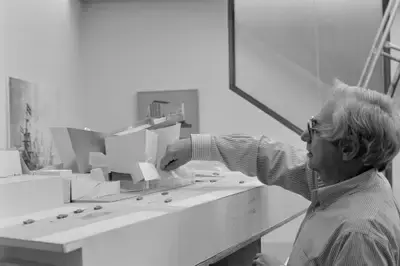
Enso’s first office occupied what had been Frank Gehry’s studio, a converted warehouse in Santa Monica where the Guggenheim Bilbao and Disney Concert Hall were born. Working in his personal studio and presentation room felt a bit magical, and a call to bravery. The turning point in Gehry’s story stays with me. For years, he designed conventional shopping malls while saving his true architectural ambition for his own home. When his client Mathias DeVito noticed this split, he asked Frank a simple question: Why? Frank’s answer: ‘Because I have to make a living.’ DeVito urged Frank to bring his true creative vision into his commercial work. To stop designing what he thought the world required of him, and start designing what he actually believed in. It was at that moment that Frank Gehry became the Frank Gehry we all know. He described the commitment as ‘like jumping off a cliff’. The world is immeasurably richer for that leap; his work proved that working with deep conviction and commercial success aren’t in opposition. Of course, that leap is available to all of us, and every company. Mathias DeVito did something rare: he gave Frank permission to become fully himself. Becoming is a team game, and each of us can help, and can use the help. RIP Frank. (SB)
These nuggets are curated by ENSO partners Hanna Siegel (HS) and Sebastian Buck (SB).
7 things that made us think, gasp, share and laugh:
- Notorious sibling rivalries throughout history
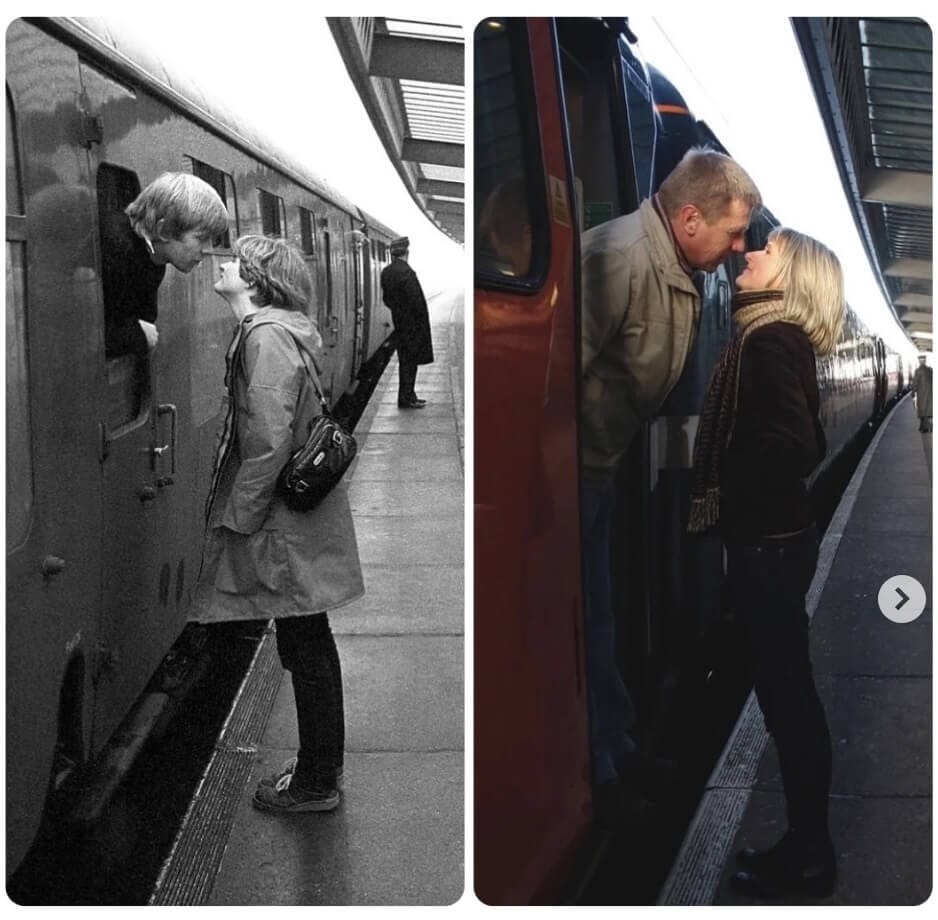
- Photographer Chris Porsz spent the 70s, 80s and 90s taking pictures of people in their everyday lives. Decades later, he went back, found those people, and recreated the same moments.

- How nature inspired velcro, shock-absorbing materials, medical implants and much more
- Why culture may be our most powerful lever for progress
- From the Dept of Holiday Cheer: Between DOGE cuts and the government shutdown, the National Parks and the Rangers who take care of them have suffered. So someone created the Adopt-A-Ranger program that matches Rangers in need (of money, a supportive letter, a holiday meal or anything in between), and people who want to give. Within its first week, hundreds have signed up.
- We’ve written before about the different ways to win, and new F1 champion Lando Norris is a great model for moving beyond aggressive rivalry: ESPN: ‘you can be a world champion being a nice guy’
What we’re working on
ENSO is a small, senior team so that we can work on just a few initiatives at a time. This allows us to go deep on some of the biggest challenges/ opportunities. Recently, we’ve been working on a few main missions with our partners:
- Remembering the best of us to tell a new American story. How can we create a cultural moment that generates a new set of shared values about who we are?
- I (Hanna) have started to write more about many of the topics we talk about here on The Hannalyst. Check it out for slightly longer (but still lunch break-friendly) pieces on optimism, designing the future and more.
- Changing the world of work: the labor market is the engine of prosperity, but ~80% of people are not engaged or thriving. We’re working to change the system.
- Helping artists sustain an artistic life over the long term: Designing the space and tools to help artists everywhere thrive.
As the year comes to a close...
At ENSO, we work every day to create more positive futures — for people and companies. The most meaningful gifts are the ones that expand opportunity and help us move toward a future we all want to be a part of. In that spirit, ENSO is making a monetary donation to Defy Ventures, a nonprofit helping people with criminal histories build new pathways through entrepreneurship, career readiness, and personal development.
Thank you for being part of the network that fuels our optimism and expands what’s possible. We’re grateful for you, and we’re committed to building a future worth fighting for — together.
Want regular inquiries? Subscribe here to get our thoughts in your inbox every so often.
Reach us at news@enso.co
See you next time.
ENSO • 115 W California Blvd #9101 Pasadena, CA 91105